Monday, 31 March 2014

He dresses nicely, is he gay?

Oh he dresses nicely, is he gay?

Hello Class! (=^_^=)
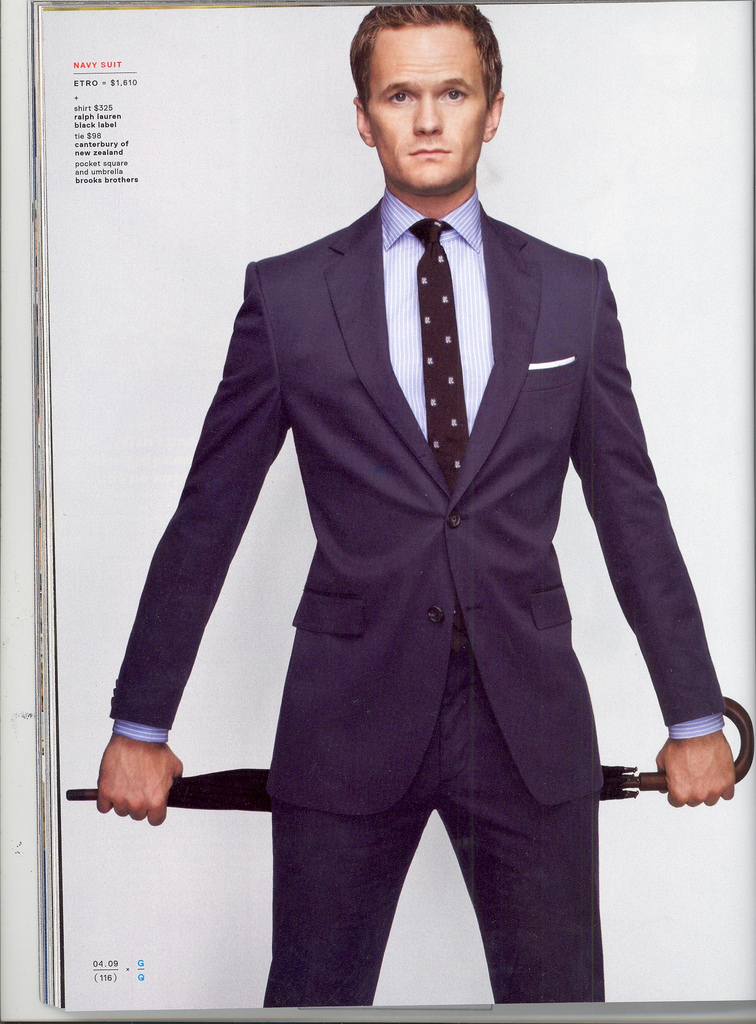
Many of us have been downtown. Have you seen that one guy who randomly catches your eye? Not because he’s features are good looking or his eyes are amazing. It’s because he’s dressed like one of those men that we fan girl/boy over during movies or in magazines. Then comes the moment where we question their orientation.

Trust me; I've come to a lot of random conclusions. Now a day’s we've seen in our own society, that men with the most fashionable taste are sadly gay. 

On the other hand, have we ever considered a straight man loving fashion without any of us assuming he has a slight interest in men or he’s gay?

If you've watched TV these days, shows portray the gay men with the most stylish looks, however, if we take a look at the straight guy he’s in a t-shirt and jeans. The show Glee for example, Kurt (The gay male in the show) is the classiest dressed man in the series. 

Now many of us might say it’s cause he’s gay, now let’s try to put a straight guy in his position. Can you imagine a straight man liking glitter, even I can’t imagine that. Is this a new type of discrimination? Men who like fashion are gay.

This also goes for women. How is it easy to tell if a woman is straight or not?

It’s not only media who encourages these false ideas, but also stereotypes. It’s true that gay men do dress well, however, does that apply for all men. That only gay men should dress nicely and get away with it? But where do these stereotypes start from?  Danny Keefe, a first-grader from Bridgewater, Massachusetts, who suffers from a speech impediment, has become the target of bullies who called him a baby and ridiculed him for wearing a suit and tie to school. (Farberov, “Mail online”)

{Kim Bum from Shinee}
We as kids always had our parents dress for us. Many of us fit in, and others didn't. However, why does bullying happen? The best answer I could find was “The fact that one gets more social recognition for behaviours can also contribute to reasons why people bully” (Bullying Statistics, “Why do people bully?”) 

Different is the key word used when it comes to describe this type of situations. Now when it comes to the real world and we forget about school and all these ideas of bullying, there is still the idea that these males are gay for dressing good.

A lot of straight men are hiding their potentials because they are afraid of what society “might” view of them. Guy Trebay, a New York Times journalist writes “Designer fashion is no longer just for gay men and Europeans. Welcome to the age of sartorial enlightenment, in which the average male has shed schlumpiness for style.”(Guy Trebay, “Tmagezine”) 

There is society who is encouraging, yet contradicting itself for the amount of stereotypes they are creating and because of this many men feel threatened by fashion, by style and by taking pride in one’s appearance. (James Gallichio, “The stigma of the well dressed man”) I mean its 2014 come one; I doubt anyone would negatively comment on how greatly you’re dressed. ;)
Questions~
  1.  Why do you think it’s hard for straight men to express their love for fashion without being judged in society? Do you believe it’s another form of discrimination?
  2.    How do women suffer from the same idea? Is it harder for women to express themselves as person who would rather dress manly than womanly?


Work Cited
Gallichio, James. "The Stigma of the Well-Dressed Man." A Good Man. N.p., n.d. Web. 31 Mar. 2014.<http://agoodman.com.au/stigma-of-the-well-dressed-man/>.
Trebay, Guy. "The Rise of the Well-Dressed Man." T Magazine The Rise of the WellDressed Man Comments. N.p., 27 Feb. 2013. Web. 31 Mar. 2014.<http://tmagazine.blogs.nytimes.com/2013/02/27/the-rise-of-the-well-dressed-man/?smid=tw-share>.
Farberov, Snejana. "Touching moment a fifth-grade football team stands up for their special-needs waterboy, 6, who was bullied for wearing suits to school... by dressing just like him." Mail Online. Associated Newspapers, 25 Nov. 2013. Web. 31 Mar. 2014.<http://www.dailymail.co.uk/news/article-2512633/Kindness-suits-Moment-fifth-grade-football-team-rallies-bullied-special-needs-waterboy-likes-wear-jackets-ties-dressing-like-him.html>.
Unknown, Unknown. "Why do People Bully?." - Bullying Statistics. N.p., n.d. Web. 31 Mar. 2014.<http://www.bullyingstatistics.org/content/why-do-people-bully.html>.

"You Don't Look Gay."


From when I was a baby until the age of nine, my parents hired housekeepers  or nannies to take care of my siblings and I, and also to do house chores. They were usually female housekeepers however, when I was about eight years old, my parents hired a gay housekeeper. He was tall, thin, and had shoulder length hair. He stayed in a room that we previously had and still had all our (my siblings and I) clothes in it. So one time, I was looking for something in his room and I opened one of the drawers, I found his underwear. He had men’s underwear. This stunned my eight year old self because I expected him to wear women’s underwear. He was feminine in his actions and used stereotypical gay lingoes. Through the media, I was introduced to the stereotypes of how gay men would act and what they would wear.

The media in the Philippines portrayed gay men as people who wear scarves around their necks, even though it was 25-27 degrees outside, and who also acted very feminine. Some of them even wear women’s clothes, with a lot of sequins, and a fringe swept to one side of their face. Society assumes that gay men must act feminine and men that are slightly feminine are presumed gay.

Gay men aren't the only ones that are victimized by these stigmas. Stereotypes against lesbians also exist.  They are assumed to act and look masculine. Lesbians are portrayed in the media as independent and tough women who have certain dislike towards men. Gay people that don’t usually have the feminine or masculine characteristics are often confronted by this statement: “But you don’t look gay.” People are used to seeing feminine gays and masculine lesbians in the media that they think those are the only possible characteristics they would have.

These stereotypes exist because we allow the media to influence us about these ideas. Even gays and lesbians don’t like how they are portrayed in the media, they want more realistic and diverse characters (Robinson).    

However, these awesome people show society that not everyone fit into the stereotypical gay characteristics:  
Neil Patrick Harris
Matt Bomer

Portia de Rossi

In the recent years, the media has been trying to lessen characters that are stereotypically perceived as gays and lesbians. Now, they are showing more gays and lesbians that don’t fit the stereotype or introducing characters that do not follow society’s expectations of them.  The TV sitcom, How I Met Your Mother, shows a perfect example of how gay men don’t have to have feminine characteristics. James, Barney’s brother, is portrayed as a masculine man who can attract heterosexual girls.
Wayne Brady played Barney's gay brother
Another example is the Danny from Teen Wolf. He is the opposite of the stereotypical gay men. He is considered a jock at their high school and has no femininity in him.
Keahu Kahuanui plays Danny 
However, I think that these stereotypes shouldn't exist anymore. Gays and lesbians can look and act like a heterosexual person, its just that they are attracted to the same gender. Just like how heterosexual men and women shouldn't have to justify their sexuality because they don’t look and act like the social norm.


Questions :
 
  • So, what if you were in there place and were asked why you don’t look like the social norm for your sexuality, how would you feel?
  • Why do we have to categorize ourselves to a certain gender?
  • Why can’t we just be people that accept how each of one of us look?
  • Do you think stereotypically gay men and women are more accepted in the society or the ones that don’t fit into the stereotype?
  • Do you think stereotypes will ever go away?


*None of these photos are mine and only using them for education.


Robinson, James. "One in five unhappy with portrayal of homosexuality on TV, report claims." The Guardian. Guardian News and Media, 30 Sept. 2010. Web. 31 Mar. 2014. <http://www.theguardian.com/media/2010/sep/30/one-five-uncomfortable-homosexuality>.


Saturday, 29 March 2014

Female Athletes = Sex Icons

I have never been interested in sport but I’ve seen some games while flipping through the TV channels and have watched my family and friends enjoy watching their favorite teams play. The one thing I noticed is that the games being watched and broadcasted are almost 100% male athletes which made me think which channel to go watch a female athlete play.

Yes! There is something called a female athlete, but how would we know unless the Olympics are on?


I typed in “female athletes” in Google and I would like to share with all of you the first thing that came up.

The top number of the “hottest” or “sexiest” female athletes, Isn’t that exactly what I was looking for when I typed in “female athletes” and not some well-known female athletes who are known for their skill and game rather than their body.

Female athletes are the cover pages for men magazines and are taken to advertise products on television. I’m sorry am I getting this concept wrong? Does the word athlete not define someone who plays sport? Or is it the word “female” that changes its definition to “sex icon/symbol”? 

Sadly, we are all well aware of how women are portrayed in the media as sex symbols, but I was extremely shocked to see that even female athletes that should be role models for generations of girls to come are known for their sex appeal rather than their athletic skill. Female athletes are seen more concerned about how they look rather than their game, as clearly there are more sex appealing photo shoots than game broadcasting. The number of female athlete has increased a lot in the past few years but they still get minimum attention from viewers and sponsors, even though they take an extra step to bend over for the media.  The field of sport is one of the most discriminatory towards females as it is clearly known to be unfeminine due to which a lot of female athletes have to show off their “feminine side” to the world. Female athletes then bend over for the media and or pose with their kids and husbands for pictures just to be safe from the word lesbian or manly. 


Female athletes put the same amount of effort into their sports, the same commitment and dedication and follow the same routine like any other male athlete but still end up receiving only 1% of the sponsors from the entire market. 40% of the national participants are made up of females but still they are never a front page story on a newspaper and out of the entire sport coverage only receive a maximum of 8%.

Let’s look at some examples of well-known female athletes.

#1 Anna Kournikova 

Anna Kournikova is Russian American tennis player who is better known for her sexy body than her tennis skill that are not worthy of the fame she has received. She has not won a WTA (Women Tennis Association) but has received great sponsorship deals. She has made more money doing half naked photo shoots than playing the sport she should be known for.                                                                     


#2 Victoria Pendleton


Victoria Pendleton is an amazing athlete, well worthy of her fame as she is World and Olympic Cycling Champion. She chose to pose for “sporty” lingerie for the FHM magazine which did not look any different from a victoria secret’s lingerie. 


#3 Danicia Patrick 


Danicia Patrick is the first female to compete directly against males in open wheel racing which makes her a very prominent figure in American sport history. She has gained a lot of fame through her go daddy campaign where she appears naked in showers

 < one of the go daddy commercials 


All three examples of the athletes have portrayed themselves as sex icons even though being incredible in their sport except Anna Kournikova.This tells us that even if you are a great athlete a sex appeal in a necessity to stay in the public's eye.

What are the reasons behind being a sex icon?

  • Gaining sponsors 
  • Gaining male spectators 
  • Market the sport 
  • Show off femininity 
What are the effects of this kind of portrayal?
  • Girls leave athletic careers
  • Female athletes are not taken seriously
  • Female athletes are not respected
  • sexism continues

If we look upon female athletic gear we can see how tight their kits are and to what extent they expose their bodies. I would like you guys to compare the following pictures.
DO YOU SEE THE DIFFERENCE? 

 I really recommend to watch this video as it summarizes the whole topic.
  

If this kind of publicity continues i highly doubt women will ever get out of this sexism issue and will always be seen as sex objects and the weaker gender.

Please answer at least 3 of the following question.

1.Why don’t male athletes need to use a lot of sex appeal ?
2.What can be done to stop sexism towards female athletes?
3.What are other ways to promote female athletes ? 
4.Do you follow any female sports .. if not why ? 
5.Do you think that its right for a female athlete to wear a skimpy athletic gear?
6. Do you think sex appeal is right ? 

Citations 

(2005). The Portrayal of Female Athletes in the Media. [ONLINE] Available at: http://janisgonzalez.wordpress.com/2009/10/23/the-portrayal-of-female-athletes-in-the-media/. [Last Accessed 29/3/14].
(2013). Danica Patrick. [ONLINE] Available at: http://en.wikipedia.org/wiki/Danica_Patrick. [Last Accessed 29/3/14].
Georgina Farrer (2010). Sex symbol or sports star?. [ONLINE] Available at: http://www.femalefirst.co.uk/sport/women+in+sport-2092.html.[Last Accessed 29/3/14].
The Naked Truth. [ONLINE] Available at: http://faculty.elmira.edu/dmaluso/sports/sexappeal/sexappealtopic.html.[Last Accessed 29/3/14].

Saturday, 15 March 2014

Sexualized Women in the Media?

      Have you ever watched the news or looked at the magazines and saw many women wearing only but a bikini? Whether you play video games, watch t.v, read the newspaper, look at magazines, etc.. you will most likely see women being portrayed as nothing but an object to be used for someones personal sexual desire or even for money. Video games like GTA 5 has strip clubs which are run by gangsters or people connected to the mafia and it shows women in bikinis who's bodies are used to feed the pockets of the members or the mafia.
     I have seen many magazines where the man is on top of the woman or when there are three or four men all around one woman. All the men are half naked and the woman is wearing nothing but a bikini. Have also seen many walkthrough games where the woman are only used for prostitution or to rid the urges or the man by having sexual intercourse. These kinds of games and magazines portray to the society that women are only to be seen as sex objects or are only meant to stay home and cook and clean and look after the kids.
                  Many centuries have passed. Many great people sacrificed their whole life so that in the future everyone can be treated equally wherever they go. However, when I see women on the t.v, magazines and even games being treated as sex object and putting the image in the minds of kids everywhere who see these kinds of things just doesn't seem right. As you can see all these pictures that I have found on google images show women with bikinis or really short underwear pant looking things and even a woman who isn't wearing anything on the top but when looking at the men they are either dressed very nicely with nice clothes covering almost their entire body it kinda shows the huge difference between men and women in the media.
     Researchers have done studies to show how the Rolling Stone magazine have changed the outlook of women from 1960's to 2000's. In the 1960's they found that 11 percent of men and 44 percent of women on the covers of Rolling Stone were sexualized. In the 2000's 17 percent of men (6 percent rise) were sexualized, and 83 percent of women (doubled) were sexualized in most of their magazines. A WHOPPING 44 PERCENT RISE!! The statistics proves that even though we have gone from hating on African-Americans to living with them in the same society, women on the other hand are being treated like dolls.
    Overall, I believe that what the media, magazines, t.v, video games, etc... are not something that should not be permitted due to the fact that it could lead to many negative aspects for the future generations.

Questions for the class to answer :)

1) When you guys become a parent yourselves one day want your child to want to see these kinds of things and have these kinds of people to become their role model and people to look up to?
2) Why is it that even though there are a lot of jobs out there that give you good income women choose to do things like these? It may be easy money but is it worth losing your pride and morals over?
3) Do you as a person believe that the media or video game industries is right in trying to promote these kind of things to little kids and teenagers? Are they trying to make the future a better place to live in or are they trying to destroy everything that the past generation have gave up most of their years to achieve?


http://psychcentral.com/news/2011/08/11/medias-growing-sexualization-of-women/28539.html


"MAN UP"-Said by almost everyone.

I've always wondered to myself, what is masculinity? What does it exactly mean to be “masculine”?  When thinking of masculinity, what phrases or words come to mind? When asking various individuals this question, the responses I came across were quite interesting. The most commonly used words expressing masculinity were: aggressiveness, restricted emotions, desire for status/power, self-reliance, dominance, and strength. The interesting correlation I found was that all of these words were very similar in expressing one main premise: “masculinity” is the exact opposite of what is deemed “feminine"
In deeply studying the concepts of femininity in the past, I found that masculinity and femininity seem to be the perfect opposite of each other. Where the traditional woman was gentle, the man was aggressive. Where the traditional woman was emotional and sensitive, the man exuded no emotions. Where the woman was passive, the man was aggressive, and so on. 
Because masculinity was made out to be the perfect counterpart of femininity, we can get a general understanding of why it’s looked down upon for the two to ever interlope. For a man to posses’ gentleness and sensitivity, traits that are typically deemed feminine, he would be referred to as a sissy or a weakling. And that’s just it, to be anything like the woman, in any shape or form, is to be fragile

is to be passive
is to be "weak".
To truly “be a man” is to be nothing like a “woman”("Gender Identity") 

And I found that very concept to be so intriguing.

Of course, because men were the bread-winners and women were the bread-makers; we can get an understanding of where these personality traits and stereotypes originated from. But needlessly to say, society has advanced, and is still continuing to advance. It’s 2014, and we’re constantly undergoing positive change in many aspects of life (work, home, technology, equity/equality)

So... while we’re aware of these prehistoric beliefs
Have you ever wondered how they're being promoted and endorsed today? How exactly is “masculinity” portrayed today?
Let’s zero in on one of the biggest contributors of our understanding today:

The media
(DUN DUN DUN)

Yes the good old media

Of course, with the help of growing technology, the influence of the media has grown rapidly. But how has the media merged those prehistoric beliefs regarding masculinity into our society today?
Some may recall through: billboards, action movies, television sitcoms etc. Through these means, traditional masculinity" is  promoted.


However, let’s take a closer look at an interesting study conducted by psychologists Megan Vokey, Bruce Tefft and Chris Tysiaczny from the University of Manitoba.  Through extensive research of advertisements in men’s magazines (ex. Playboy, Field and stream, game informer etc) they concluded that the main messages promoted by these magazines were:
a)    Violence will always be manly
b)    Men must exude toughness
c)    Danger is exciting
d)    Toughness is a form of emotional self-control

Furthermore, they also found that these messages were likely to appear in magazines targeted towards younger, lower-income, and less educated readers.
And this is where it becomes interesting. This is where we begin to understand how the media plays a role in how young boys...young men feel about themselves today.

From a young age, boys were told to “man up” in many different occasions and situations. But have we ever stopped to consider what this phrase actually means or implies? Essentially, A boy/man will always feel their manhood is put in danger, put in stake, if they choose to show their emotions in any way or form. As a result, boys will never truly feel confident and satisfied with themselves. 

An as sociologist Dr. Michael Kimmel put it so accurately:
 “We've constructed an idea of masculinity that doesn't give young boys a way to ever feel secure in their masculinity, so they have to go out and prove it all the time”
Please continue, and watch this 3 minute clip. *DO NOT SKIP*


 Time to ponder...
(Answer at least 3 of the questions) 

 Despite the media having a role in the damaging of our youth; do you feel, as a individuals, we are failing our boys?

Do you agree with Dr. Michael Kimmel (quotation)? Why or why not?

What other ways does the media promote masculinity and manliness? 

What long term affects can the “bottling up of emotions” have on young teenage boys?

Does your definition of masculinity correlate with the media’s definition? Why or why not?  

Lastly, do you believe culture has an impact on our views concerning masculinity? 

Citations:
Bahadur, Nina. "Be A Man: Macho Advertising Promotes Hyper-Masculine Behavior, Study Finds." The Huffington Post. TheHuffingtonPost.com, 7 May 2013. Web. 7 Mar. 2014.

"Gender & Gender Identity." Gender Identity. N.p., n.d. Web. 12 Mar. 2014. 


Wednesday, 12 March 2014

An Extra: A Rescue from the Chains of the Writer's Block

This is just a little excerpt I fell in love with and decided to share with the class since everyone experiences the dreaded writer's block, some more than others. With the personal essay coming up, this could be very helpful. However, don't limit it's wisdom to one interpretation. Try to use it well into university and the rest of your life, for fiction or non-fiction pieces from writings to drawings to any other medium of art you could possibly think of. I hope you find it as helpful as I did.

“Go into yourself. Find out the reason that commands you to write; see whether it has spread its roots into the very depths of your heart; confess to yourself whether you would have to die if you were forbidden to write.

This most of all: ask yourself in the most silent hour of your night: must I write? Dig into yourself for a deep answer. And if this answer rings out in assent, if you meet this solemn question with a strong, simple “I must,” then build your life in accordance with this necessity; your whole life, even into its humblest and most indifferent hour, must become a sign and witness to this impulse. Then come close to Nature. Then, as if no one had ever tried before, try to say what you see and feel and love and lose...

...Describe your sorrows and desires, the thoughts that pass through your mind and your belief in some kind of beauty - describe all these with heartfelt, silent, humble sincerity and, when you express yourself, use the Things around you, the images from your dreams, and the objects that you remember. If your everyday life seems poor, don’t blame it; blame yourself; admit to yourself that you are not enough of a poet to call forth its riches; because for the creator there is not poverty and no poor, indifferent place. And even if you found yourself in some prison, whose walls let in none of the world’s sounds – wouldn’t you still have your childhood, that jewel beyond all price, that treasure house of memories? Turn your attentions to it. Try to raise up the sunken feelings of this enormous past; your personality will grow stronger, your solitude will expand and become a place where you can live in the twilight, where the noise of other people passes by, far in the distance. - And if out of this turning-within, out of this immersion in your own world, poems come, then you will not think of asking anyone whether they are good or not. Nor will you try to interest magazines in these works: for you will see them as your dear natural possession, a piece of your life, a voice from it. A work of art is good if it has arisen out of necessity. That is the only way one can judge it.”
― Rainer Maria Rilke